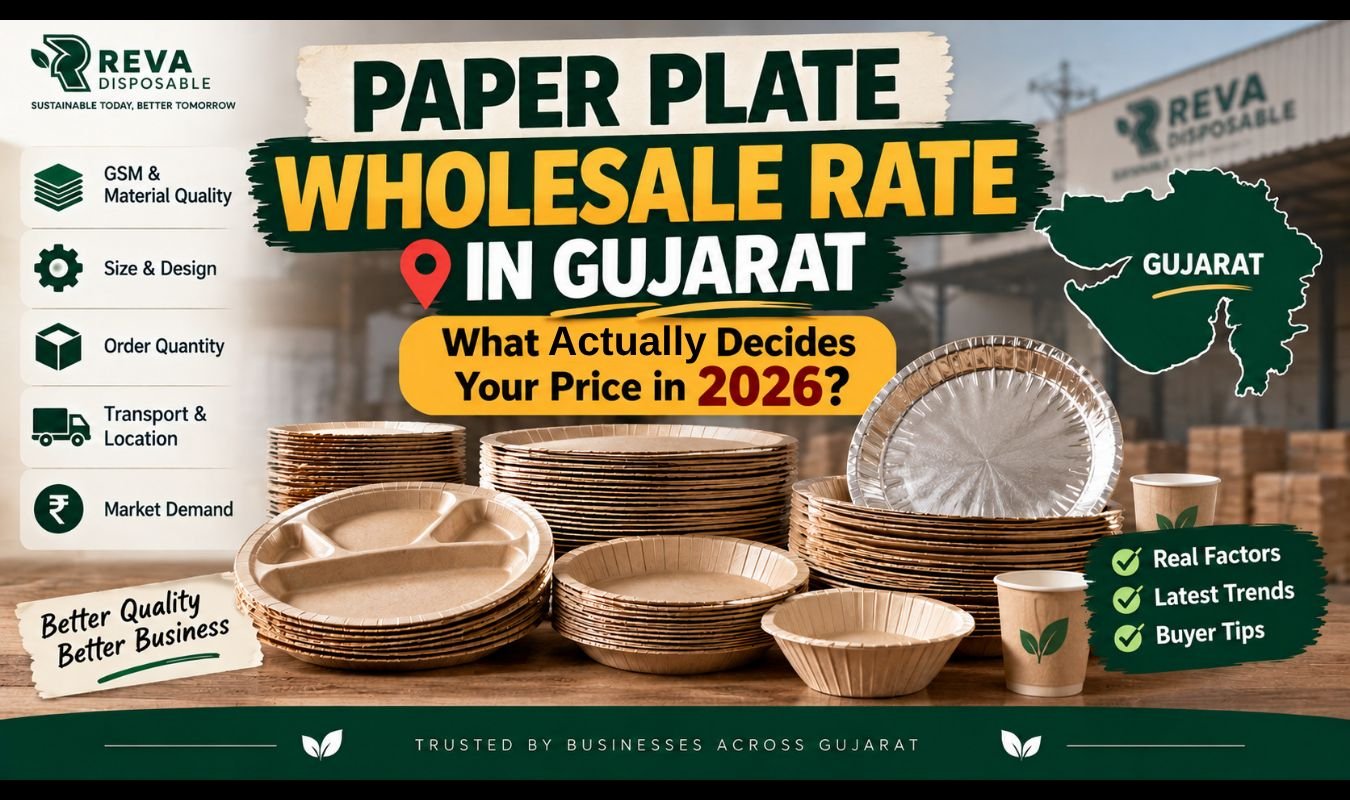
In September 2026 the paper plate wholesale rate in Gujarat sits roughly between ₹0.75 and ₹1.60 per piece for standard round plates bought by the carton. That is a wide band, and the gap is not random. Your paper plate price per piece is decided by six things: GSM (board thickness), plate size, surface finish (silver foil, leaf print or plain), order quantity, packing, and how many hands the goods pass through before reaching you. A quote is only comparable to another quote when all six are stated.
Every week someone messages us with a screenshot of a rate from another supplier and asks a fair question: why is your number different?
Usually the two rates are not for the same plate at all. One is a 10 inch plate at a light board weight. The other is a 12 inch silver foil laminated dish. Comparing them is like comparing two bags of rice without looking at the quality inside.
This guide explains exactly what moves the paper plate wholesale rate up and down, so that the next time you take a quote you know what to ask. We are a paper plate manufacturer in Gujarat and we run our own unit in Fatepura, Dahod, so the numbers here come from operating the machines, not from a price list copied off a marketplace.
Whether you are a caterer taking a wedding, a mandal treasurer planning a bhandara, a kirana wholesaler stocking for the season, or a party plot placing its first bulk paper plate order, the logic below is the same.
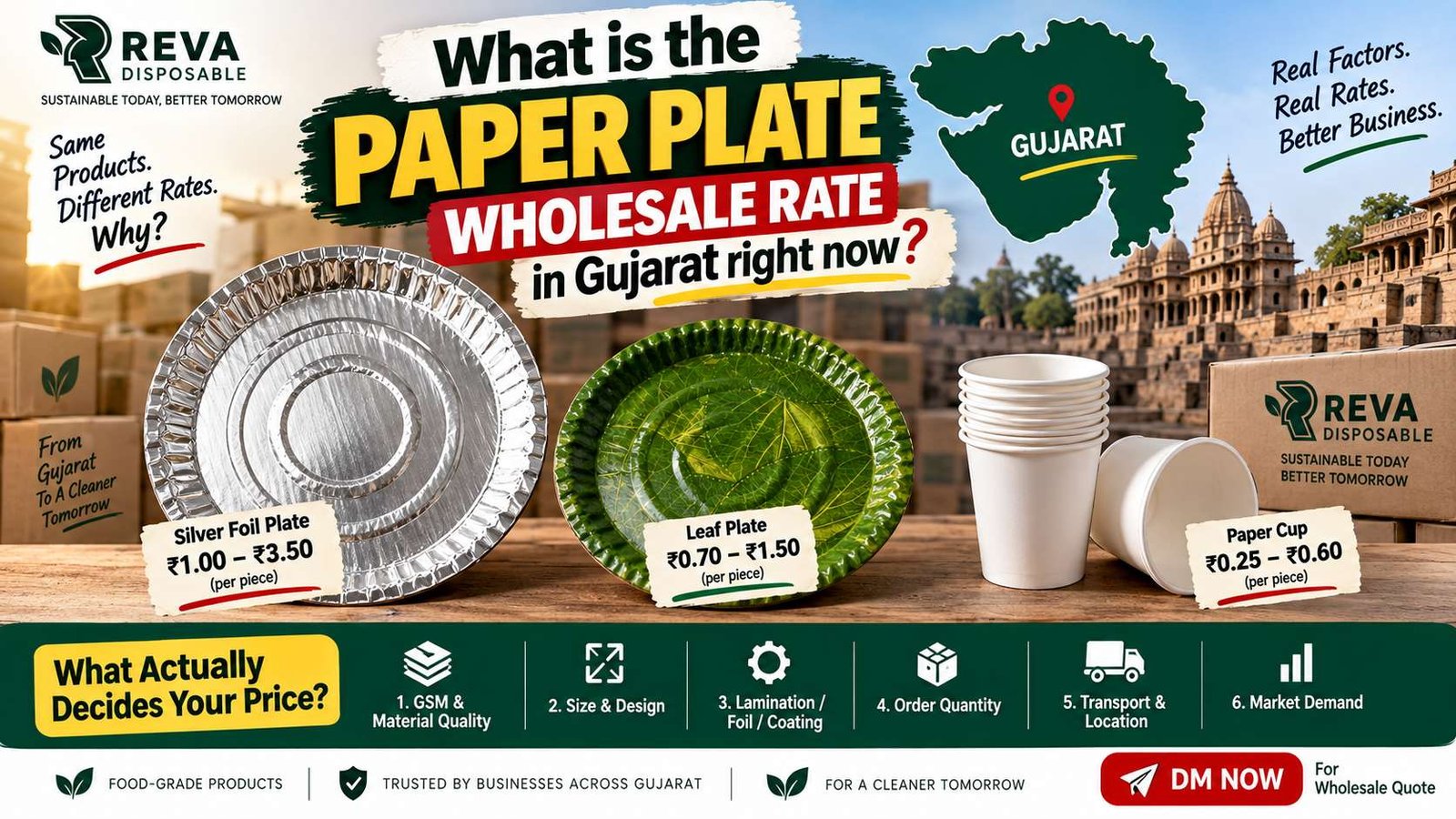
Across Indian B2B marketplaces in September 2026, listed wholesale rates for disposable paper plates run from about ₹0.75 to ₹1.55 per piece, with most standard sizes clustering in the middle of that band. Specialised items — heavy foil dishes, large compartment thalis, custom printed plates — sit above it.
Two honest cautions before you use that range.
First, a listed rate is an opening number, not a delivered number. It usually assumes a healthy order size and does not include freight to your town. Second, raw material moves. Paper board prices shift through the year, and the paper plate wholesale rate follows them with a short lag. Any rate you read in an article, including this one, is a reference point — not a commitment.
That is also why the disposable plate wholesale price you were quoted in June may not hold in October. It is a commodity, and it behaves like one.
Use this guide to understand the structure of pricing, then ask a manufacturer for today’s number. Anyone who gives you a fixed year-round rate for a commodity that follows paper board prices is either padding it heavily or planning to revise it after you place the order.
This is the part most buyers skip, and it is the part that saves money.
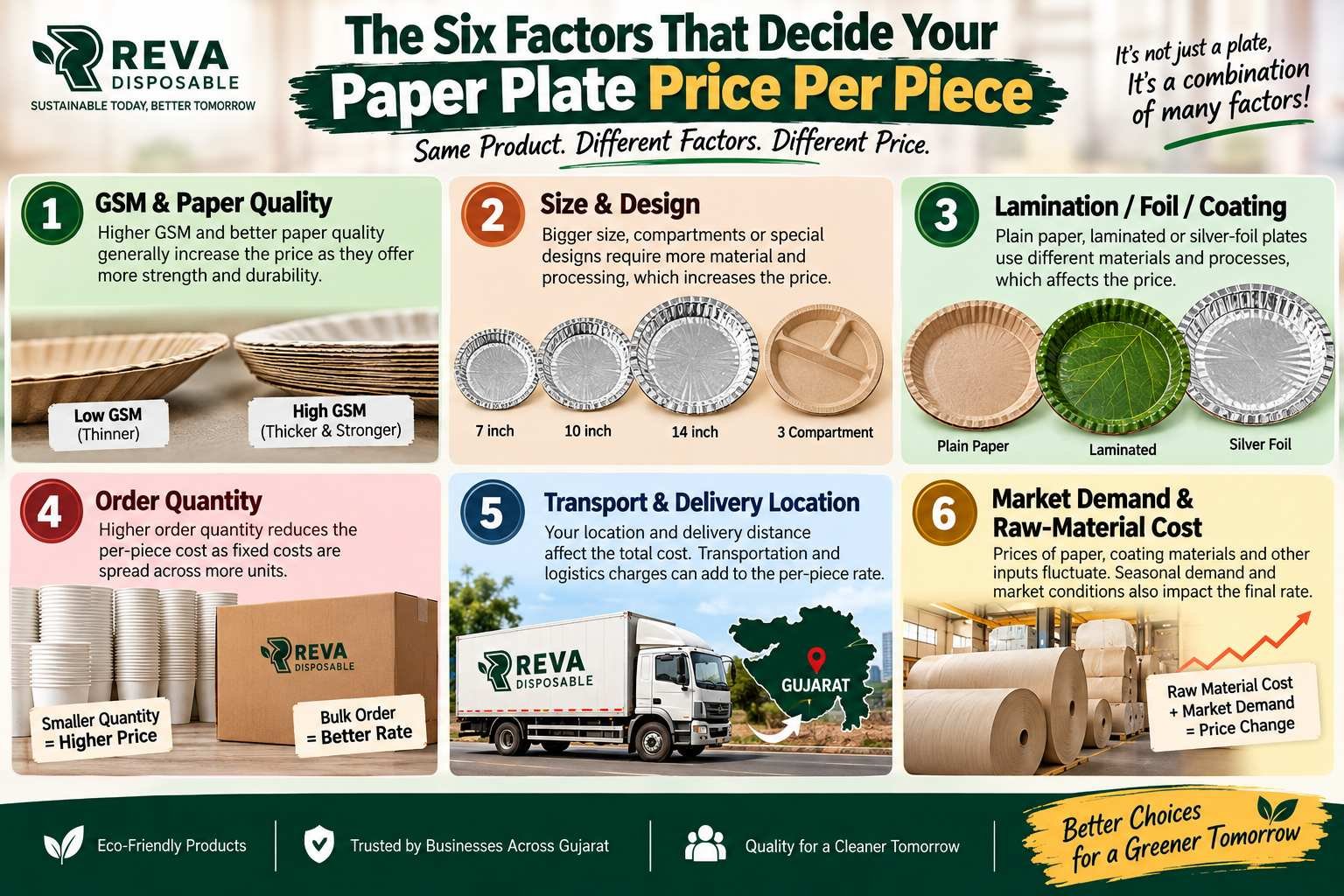
GSM means grams per square metre. It is the weight of one square metre of the board the plate is made from. Higher GSM means a thicker, stiffer plate, more raw material per piece, and a higher paper plate price per piece.
Disposable plates in the Indian market are commonly made in a band from roughly 100 to 400 GSM. Where you should sit depends entirely on what goes on the plate:
Here is the mistake that costs the most money: buyers compare a low paper plate wholesale rate against a higher one without asking the GSM of either. The cheaper plate is cheaper because there is less board in it. That is not a discount — it is a different product.
Plate diameter changes material consumption directly. Our own range runs from 4 inch up to 12 inch, and the jump from a small prasad plate to a full 12 inch thali is significant in both material and rate.
A practical tip that has saved our customers real money: most events need two sizes, not one. A small plate for prasad or snack distribution and a large one for the main meal. Buyers who order only the large size end up using an expensive plate for a laddu, and buyers who order only the small size run into trouble at the main service.
This is where the disposable plate wholesale price separates most visibly.
One thing worth saying plainly, because the industry often does not: a plastic or foil lining is what makes a paper plate hold up against oily food. That lining also means the plate is not a fully compostable product. If a supplier tells you a plate is both fully compostable and perfectly leak-proof against hot gravy, ask for the certification. Honest sourcing beats a nice-sounding claim.
Quantity is the lever you control. Machine setup, labour and packing cost roughly the same whether the run is small or large, so those fixed costs spread thinner across a bigger run.
A bulk paper plate order in carton quantities will always land at a better paper plate wholesale rate than a few loose packets. This is also why a kirana wholesaler who books a season’s stock in one go gets a number that a walk-in buyer cannot.
If your consumption is steady through the year, say so. A monthly commitment often earns a better disposable plate wholesale price than the same total volume bought in scattered pieces, because it lets the factory plan its runs.
Packs of 50 or 100, shrink wrap, printed sleeves, carton grade — each adds cost. For a mandal or a caterer who is going to open everything on the day, simple packing is cheaper and makes no difference to the meal. For a kirana store that needs shelf-ready packs with a clean look, better packing is worth paying for.
Tell your supplier which one you are. It changes the disposable plate wholesale price by a real margin.
Freight is a genuine cost and it scales with distance and volume. But the bigger and quieter cost is the chain.
Goods that travel manufacturer → distributor → sub-dealer → retailer carry a margin at each step. By the time the plate reaches you, the rate has little to do with what it cost to make. Buying from a paper plate manufacturer in Gujarat directly removes those layers. That is the entire reason a factory rate and a market rate differ.
Before you ask for a rate, decide what you are actually buying. This table is the shortlist we walk most customers through, and it usually cuts the enquiry down to two line items instead of six.
| Occasion | Typical size | Suggested finish | Why |
|---|---|---|---|
| Prasad or mithai distribution | 4–6 inch | Plain or leaf print | Dry items, no liquid to fight, smallest material cost |
| Snacks, farsan, chaat counter | 7–8 inch | Leaf print | Looks good in photos, handles semi-dry food comfortably |
| Bhandara or mandal mahaprasad | 10–12 inch | Silver foil laminated | Dal and gravy on the same plate, held in one hand |
| Wedding or full thali service | 11–12 inch | Silver foil laminated | Heaviest load, longest time between serving and eating |
| Chai, chaas, welcome drink | Paper cup | Standard | Hot liquid; cup shape matters more than plate GSM |
| Kirana shelf stock | Mixed sizes | Mixed | Customers buy small and large; stocking one size loses sales |
Two sizes and one or two finishes cover almost every real requirement. Buyers who try to standardise on a single plate for everything either overpay on the small items or run short on the big ones.
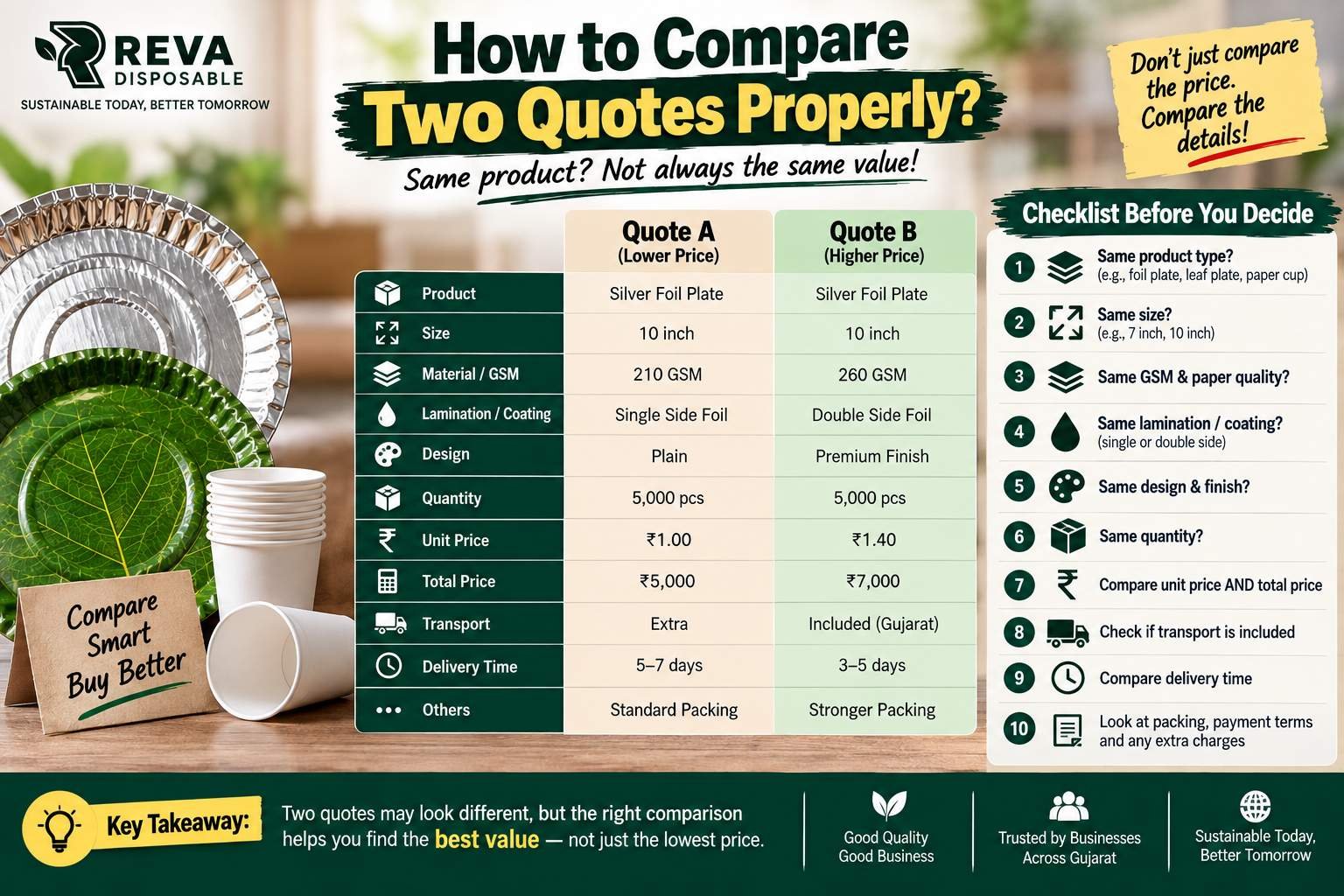
Put both quotes into the same shape before you decide. Ask every supplier for these six lines:
Then do one small calculation. Divide the carton price by the total number of pieces in the carton. That is your real paper plate price per piece. A supplier quoting per packet with a different pack size can look cheaper on the message and turn out dearer on the shelf.
Once every quote is expressed as a paper plate price per piece for the same size and the same GSM, the decision usually makes itself. Most confusion in this market is not dishonesty — it is two people quoting two different products.
Worked example. Supplier A quotes ₹95 for a packet of 100 pieces. Supplier B quotes ₹850 for a carton of 1,000 pieces. A works out to ₹0.95 per piece, B to ₹0.85. B is cheaper — but only if the GSM and size match. If B’s plate is a lighter board, A may still be the better buy.
Ordering short is more expensive than ordering slightly long, because the emergency top-up always comes at a worse rate.
The rule of thumb we give customers:
So a 500-guest bhandara needs roughly 1,200 plates, 600 bowls and 1,200 glasses. Working this out before you ask for a rate also helps you, because a bulk paper plate order with a clear quantity gets a sharper number than a vague enquiry.
For festival-season planning specifically, we wrote a separate guide on buying disposable plates for Navratri that goes through timing and quantities for garba grounds and mandal mahaprasad.
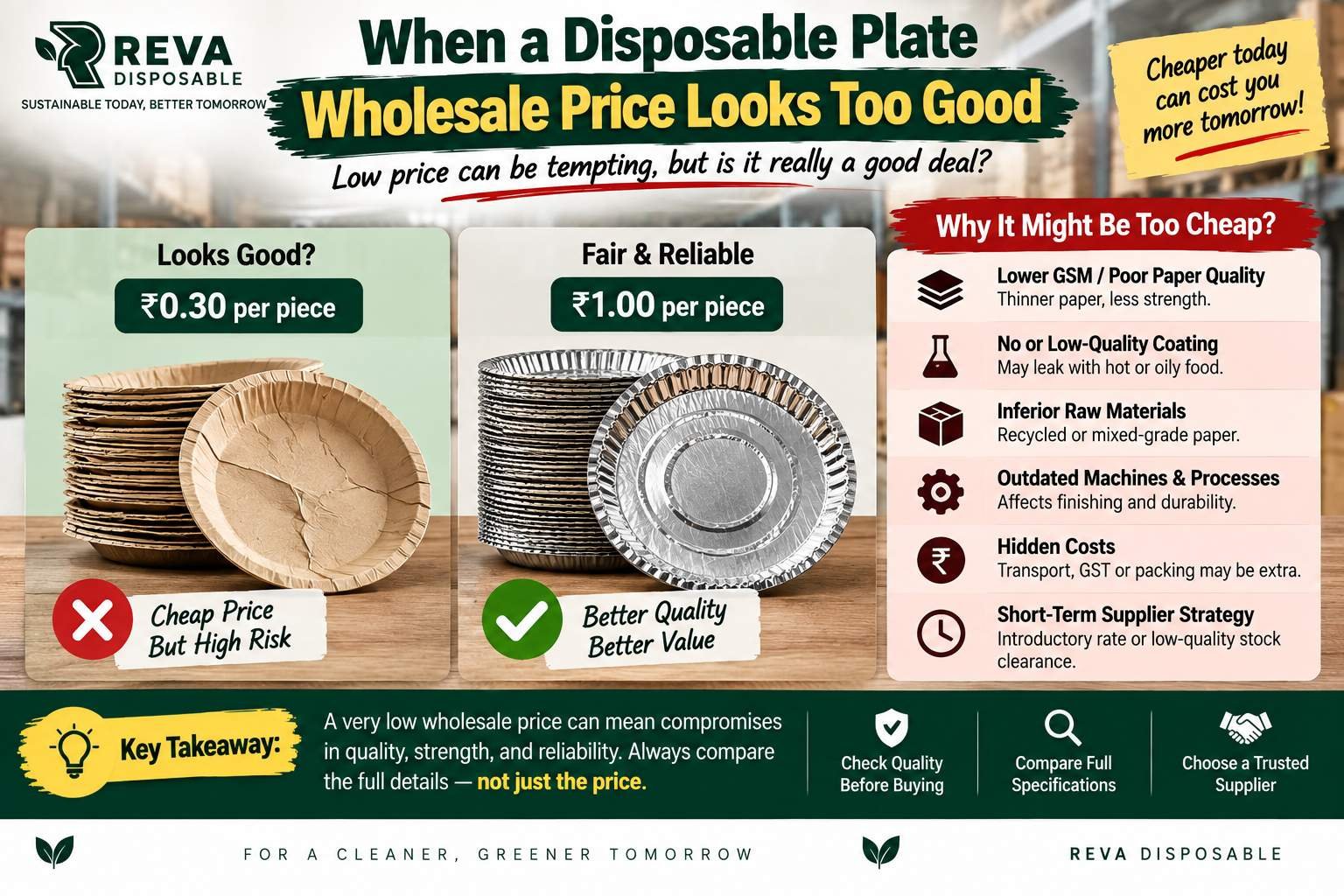
A very low number is sometimes a genuine factory rate. Often it is one of these instead.
The commonest one. Same size, same photo, less board. Ask for the GSM in writing.
Some quotes are valid only at very large volumes. Always ask: is this rate valid for my quantity?
A rate that looks 8 paise better can lose it all in transport. Ask for a delivered rate to your town.
90 pieces in a packet instead of 100 is a 10% price change hiding in plain sight. Convert everything to a paper plate price per piece and the trick disappears.
A sharp disposable plate wholesale price on the first order that quietly rises on the second is an old tactic. Ask whether the rate holds for repeat orders at the same quantity.
Both are legitimate. They suit different buyers.
A dealer makes sense when you need small, frequent quantities, want a shop nearby, or need many unrelated items in one bill. You pay for that convenience, and for many small buyers it is worth it.
Buying from a paper plate manufacturer in Gujarat makes sense when your volume is steady and your quantities are carton-level. You get the rate before margins are added, you can ask for a specific GSM, and when something is wrong you are talking to the people who made it rather than to someone who resold it.
There is a second, less obvious benefit. A manufacturer can tell you honestly when you are over-specifying. We have talked customers down from a foil plate to a leaf print plate because their menu was dry snacks and the foil was money they did not need to spend. A reseller earning a percentage has no reason to have that conversation.
One caution, in fairness: not every seller calling themselves a paper plate manufacturer in Gujarat actually manufactures. Some are traders buying from a unit and reselling. It is easy to check — ask where the unit is, ask what sizes run on the machine, and ask for a sample carton. A real paper plate manufacturer in Gujarat answers all three without hesitating.
Yes, and it is worth planning around.
In Gujarat the demand curve is steep and predictable. Ganeshotsav, Navratri, Diwali and the wedding season that follows all land within a few weeks of each other. Navratri 2026 runs 11 to 19 October, and Diwali falls on 8 November.
What happens every year is the same. Through late September and October, orders arrive together. Board demand rises, machine capacity fills, transport gets tight, and the disposable plate wholesale price firms up. Buyers who book in advance lock a rate and a delivery slot. Buyers who wait until the last ten days pay more and take whatever stock is left.
If you are planning a bulk paper plate order for Navratri or Diwali, the sensible window to book is three to four weeks ahead, not three to four days.
The same applies to Pitru Paksha and the shraddh bhoj season, and to the wedding dates that follow Diwali. None of these are surprises. A bulk paper plate order placed against a known calendar is simply cheaper than one placed in a panic.
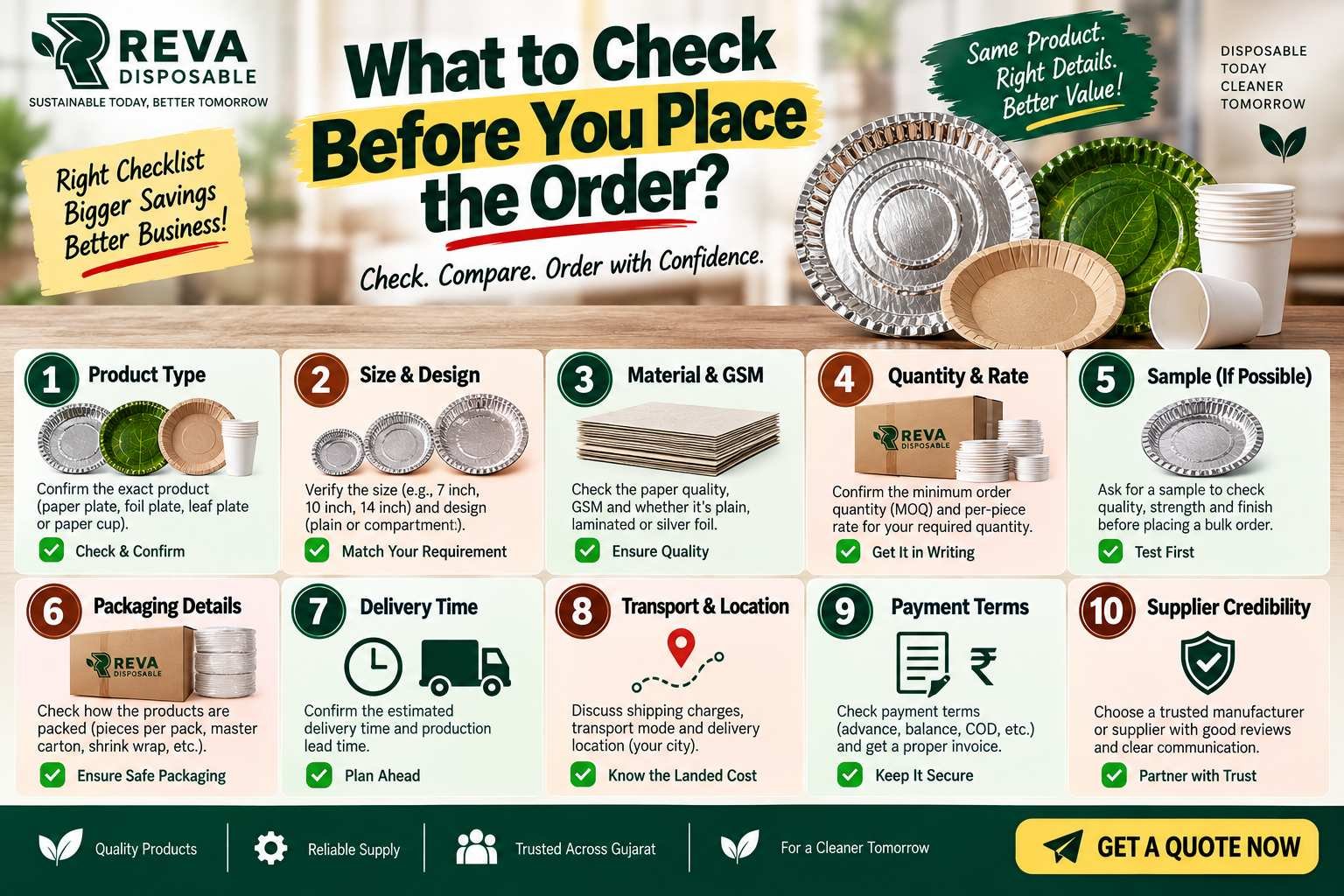
Beyond the rate itself, four things are worth confirming.
Anything that touches food should be made from food-grade board. The Food Safety and Standards Authority of India sets the framework for food contact materials in the country, and a serious manufacturer will not hesitate when you ask about it.
Single-use plastic items are restricted under India’s Plastic Waste Management Rules, and enforcement varies by state and municipality. The Central Pollution Control Board publishes the current position. If you are switching away from plastic tableware, paper-based options are part of the answer — but be precise about what is coated and what is not.
Ask for a sample carton before your first bulk paper plate order. Bend a plate. Put dal on it and leave it twenty minutes. Load a full thali and lift it with one hand. Three minutes of testing tells you more than any specification sheet, and it is the cheapest insurance you will ever buy against a bad disposable plate wholesale price decision.
Especially in season. “Ho jayega” is not a delivery date.
Most enquiries we receive say only “rate batao”. We can answer, but the reply is generic and the buyer has to message three more times.
Send this instead and you will get a precise number the same day, from us or from any serious supplier. It works whether you want one carton or a full bulk paper plate order, and it gets you a real disposable plate wholesale price instead of a vague one:
“Need paper plates for a function on [date] in [your town]. Around [number] guests. Menu is [dry snacks / full meal with gravy]. Please send size-wise rate per piece, GSM, pieces per carton, and whether delivery to [town] is included.”
That single message answers everything a supplier needs to quote properly. It is also the fastest way to find out who actually knows their product and who is just forwarding a price list.
As of September 2026, listed wholesale rates for standard disposable paper plates in India run from roughly ₹0.75 to ₹1.55 per piece, with silver foil laminated and larger sizes above that band. The exact paper plate wholesale rate for your order depends on GSM, size, finish, quantity and delivery location, and it moves with paper board prices through the year.
Divide the total carton price by the number of pieces in the carton. If a carton holds 1,000 pieces and costs ₹850, the paper plate price per piece is ₹0.85. Always compare per piece, never per packet, because pack sizes differ between suppliers.
For a full meal with dal, gravy or oil, choose a heavier board with a silver foil lamination so liquid does not soak through. For dry snacks, farsan and mithai, a lighter plain or leaf print plate is enough. Order both sizes if you are serving prasad separately from the main meal.
Usually yes, for carton-level quantities, because you skip the distributor and sub-dealer margins. A dealer is often the better choice for small, frequent purchases where convenience matters more than the last few paise. Buying from a paper plate manufacturer in Gujarat also lets you specify the exact GSM you need.
It varies by manufacturer. At Reva we work in carton quantities, and the rate improves as the order size grows. Send your guest count or monthly consumption and we will tell you the quantity break that makes sense for you rather than pushing you to a higher one.
Demand from mandals, caterers, party plots and kirana wholesalers arrives in the same few weeks. Board demand rises, machine capacity fills and transport tightens, so the disposable plate wholesale price firms up. Booking three to four weeks ahead avoids both the higher rate and the stock shortage.
Yes. Ask for a sample carton, test it with your own food, and order only after you are satisfied. Any manufacturer confident in the product will send one.
Yes. Tell us your town along with your quantity and we will confirm the delivery position and whether freight is included in the rate.
The paper plate wholesale rate is not one number. It is the output of GSM, size, finish, quantity, packing and distance. Once you ask for those six things in every quote, the comparisons become simple and the market stops looking confusing.
Convert every quote to a paper plate price per piece, ask for the GSM in writing, place your bulk paper plate order three to four weeks before the season, and buy from a paper plate manufacturer in Gujarat directly when your volumes justify it. Do those four things and you will not overpay again.
Reva Disposable manufactures paper plates, bowls and glasses at our own unit in Fatepura, Dahod. You can see the full range on our products page, read about how the unit started on our about page, or simply send your requirement and get today’s size-wise rate.
Send your size, quantity and town on WhatsApp at 96649 25059 and we will send the rate list the same day. Or use the form on our contact page.
Reva Disposable · 123, Patel Faliya, Kankasiya, Fatepura, Dahod, Gujarat 389190 · Rates quoted in this article are market reference ranges as of September 2026 and are not a price offer.
Share two details and we will send size-wise rates on WhatsApp.
