
Navratri 2026 runs from 11 October to 19 October, with Dussehra on 20 October. If you are booking disposable plates for Navratri this year, the ordering window is open right now — and it closes earlier than most organisers expect.
Most of the year, a caterer can call a supplier on Tuesday and load a truck on Thursday. Festival paper plates in Gujarat do not work that way. Between Ganesh Chaturthi on 14 September, Navratri from 11 to 19 October, Dussehra on 20 October and the five days of Diwali from 6 to 10 November, almost every buyer in Gujarat wants the same three things in the same eight weeks: silver foil plates, leaf print plates and paper cups. Demand for paper plates for garba grounds alone can triple in a fortnight.
We have run this season from inside a factory for years, and the pattern repeats. Enquiries for disposable plates for Navratri start trickling in around the middle of August. By the second week of September they arrive faster than presses can absorb them. By the first week of October, the honest answer we have to give new callers is that we can supply cups but not the 10″ and 12″ plates they wanted, because those dies have been running on committed orders for three weeks.
This guide is written to stop that phone call happening to you. It is the sequence we would follow ourselves if we were buying disposable plates for Navratri instead of making them. It covers when to order, how to calculate quantity, which plate suits which item on your menu, what the plastic rules actually require, and the specific mistakes that cost organisers money every single year.
Garba mandals and society committees serving mahaprasad after the aarti, who buy paper plates for garba nights nine evenings running. Temple trusts running a bhandara. Caterers holding three weddings and two navratri contracts in the same fortnight. Event companies handling corporate garba nights in Ahmedabad and Vadodara. Kirana and packaging distributors who stock up on festival paper plates in Gujarat before the rush and sell through in six weeks. If you are buying festival paper plates in Gujarat in any of those roles, the numbers below are yours.

Work backwards from the dates. Every year the organisers who get the sizes they wanted are the ones who placed a confirmed order before the queue formed. Use the table below as the ordering calendar for disposable plates for Navratri and the festivals on either side of it.
| Festival | 2026 dates | Order by | What moves most |
|---|---|---|---|
| Ganesh Chaturthi | 14 September | Third week of August | 6″ and 7″ plates, 65ml cups, small bowls for prasad |
| Navratri & Garba | 11–19 October | Third week of September | 10″ and 12″ plates, 250ml bowls, 100ml cups |
| Dussehra | 20 October | With the Navratri order | Same sizes, top-up quantity only |
| Diwali (five days) | 6–10 November | Second week of October | 6″ and 7″ sweet plates, 150ml cups |
A paper plate is not pulled off a shelf. Board is cut, fed into a hydraulic press, crimped, cooled, counted and cartoned. A single die produces one size at a time, so a run of 12″ plates blocks that press until it finishes. When ten mandals want 12″ plates in the same week, the tenth caller waits. Placing a confirmed order four weeks ahead is what puts your quantity into the production plan instead of the waiting list. This is true of every unit making festival paper plates in Gujarat, not only ours.
There is a second reason. Paper board pricing firms up as festival demand builds. A rate quoted in late August is usually a better rate than the same quantity quoted in the first week of October, and it is locked in writing rather than moving with the market. Anyone quoting festival paper plates in Gujarat is working off the same board cost.
This is the question we answer most often, and getting it wrong in either direction is expensive. Order short and someone drives to a market at 9 pm. Order long and cartons sit in a store room until next year, slowly absorbing monsoon damp.
These ratios come from repeat orders, not from a template. They are the figures we use when an organiser asks us to sanity-check a quantity of paper plates for garba service before they confirm.
Start with realistic headcount, not the guest list. For a garba mandal, count the people who actually stay for food, which is usually 60 to 75 per cent of those who dance. That single correction is the difference between the right number of paper plates for garba nights and a store room full of leftovers. For a bhandara, count the peak hour and multiply, because turnover is continuous.
Assume 500 dancers a night, of whom 400 eat. One meal per night, nine nights, one wet item plus tea and water.
| Item | Calculation | Before buffer | Order (with 12%) |
|---|---|---|---|
| 10″ silver foil plates | 400 × 1.25 × 9 | 4,500 | 5,040 |
| 7″ leaf print plates (prasad) | 500 × 0.11 × 9 | 495 | 560 |
| Silver foil bowls | 400 × 0.7 × 9 | 2,520 | 2,825 |
| 100ml paper cups | 400 × 1.6 × 9 | 5,760 | 6,450 |
The same worksheet scales for any mandal size, and it is worth keeping, because next year’s paper plates for garba order starts from this year’s actual usage. Round each line up to the nearest full carton when you place the order — part cartons cost more per piece and are harder to store. Any bulk disposable plates supplier worth using will tell you the carton count per size before you confirm, not after.
The same ratios hold at any scale, which is why distributors use them to plan festival paper plates in Gujarat for a whole district. For a 1,000-person mandal, double it. For a bhandara serving 3,000 people across four hours, count 3,000 heads but drop the cup figure to 1.2 per head, because people do not linger. For a corporate garba night with a live counter, raise the plate figure to 1.5 per head, because plated service produces more part-eaten plates.
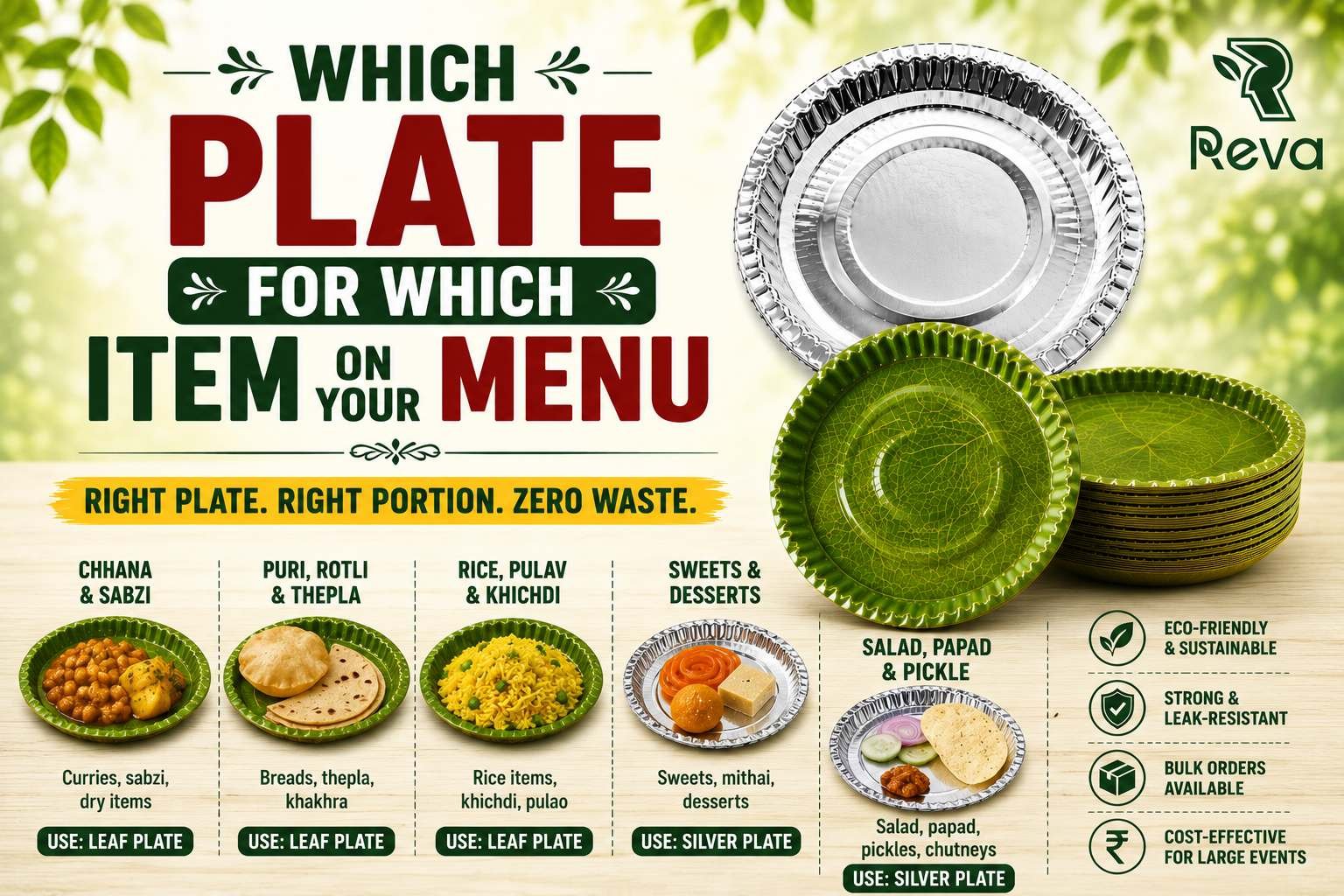
Nine out of ten complaints we hear about disposable plates come down to one thing: the wrong plate under the wrong food. A plate that leaks is not a cheap plate, it is a failed plate.
If the menu has dal, shaak, sambar, kadhi, ras or anything cooked in ghee, the plate needs a foil laminated top layer. The foil is what stops oil and gravy soaking into the board and softening it. This is the workhorse of Navratri catering and the reason silver dominates when organisers buy disposable plates for Navratri in bulk.
Sizing rule of thumb: 10″ for a full thali with three items, 12″ when you are adding rice and a sweet. Going one size up costs a few paise more per plate and prevents the single most common failure, which is food pushed to the rim and over the edge. You can see the full range on our silver paper dish page.
Leaf design plates are printed to resemble a traditional patravali, and during festival season they do a specific job. Temples use them for prasad because the look suits the occasion. Garba organisers use them at the snack counter for dhokla, kachori, fafda and dry sweets, which is where most paper plates for garba evenings are actually consumed. Decorators use them where the plate will be in the frame of every photograph taken that night.
They are not the plate for thin gravy. Use paper plates for garba snack counters and pair them with a small foil bowl if anything wet is going on the same plate. Sizes run 8″, 10″ and 12″ — details are on the leaf print paper dish page.
The small foil laminated bowl is the piece most organisers forget until the first night, even when the rest of the eco friendly disposable plates order is planned well. It holds the item a flat plate cannot: shaak, dal, curd, halwa, ras, or a chaat portion. Adding bowls to the order is what lets you serve a full thali without hiring steel katoris, washing them and counting them back at 1 am.
Water, chaas, tea, coffee, cold drinks. Four reasons for one person to take four cups in one evening. For garba nights, 100ml is the size that moves; for a bhandara with tea service, 65ml and 150ml split the volume. Food grade white cups handle hot and cold both, and food-contact standards for such material sit with the Food Safety and Standards Authority of India, and printed cups are available if you have a sponsor logo to carry — though printing needs a minimum run and a longer lead time, so decide early. Our range is on the tea paper cup page.

This is no longer a preference conversation. India’s ban on identified single-use plastic items came into force in July 2022 under the Plastic Waste Management Rules, and it covers plastic plates, cups, cutlery, straws, stirrers and thermocol used in decoration and serving. Enforcement has tightened rather than loosened since, and the Central Pollution Control Board coordinates it with state boards. The official notifications and item list are published by the Central Pollution Control Board, and the rules themselves sit with the Ministry of Environment, Forest and Climate Change.
For a garba ground or a temple trust, three practical consequences follow.
A large festival gathering is a visible, easily inspected venue, which is why most committees have already moved to eco friendly disposable plates. Thermocol plates and plastic cutlery at a public event are the easiest possible enforcement target, and the penalty lands on the organiser, not the supplier who sold them. Switching to eco friendly disposable plates removes the exposure entirely.
If your event is on municipal land, in a school ground, or funded through a trust, the committee will usually ask what tableware was used. Eco friendly disposable plates that are entirely paper based give a clean answer to that question. It is worth asking your supplier to state on the invoice that the goods are paper based, so the document itself carries the answer. An invoice that names eco friendly disposable plates in plain words is easier to file than an explanation given later.
Corporate sponsors increasingly ask what happens to the waste. A mandal that can say its plates and cups were eco friendly disposable plates from a paper-based manufacturer has an easier sponsorship conversation than one that cannot. This is a small point that has grown noticeably over the last three seasons, and eco friendly disposable plates now appear in sponsorship briefs by name.
One caution on wording: “biodegradable”, “compostable” and “paper based” are not interchangeable, and compostable claims in particular carry certification requirements. Say what is true of your goods and no more. Every item we make is paper based with a foil or printed top layer, and that is exactly how we describe it. Buyers looking for eco friendly disposable plates should ask any supplier for the same plain description.
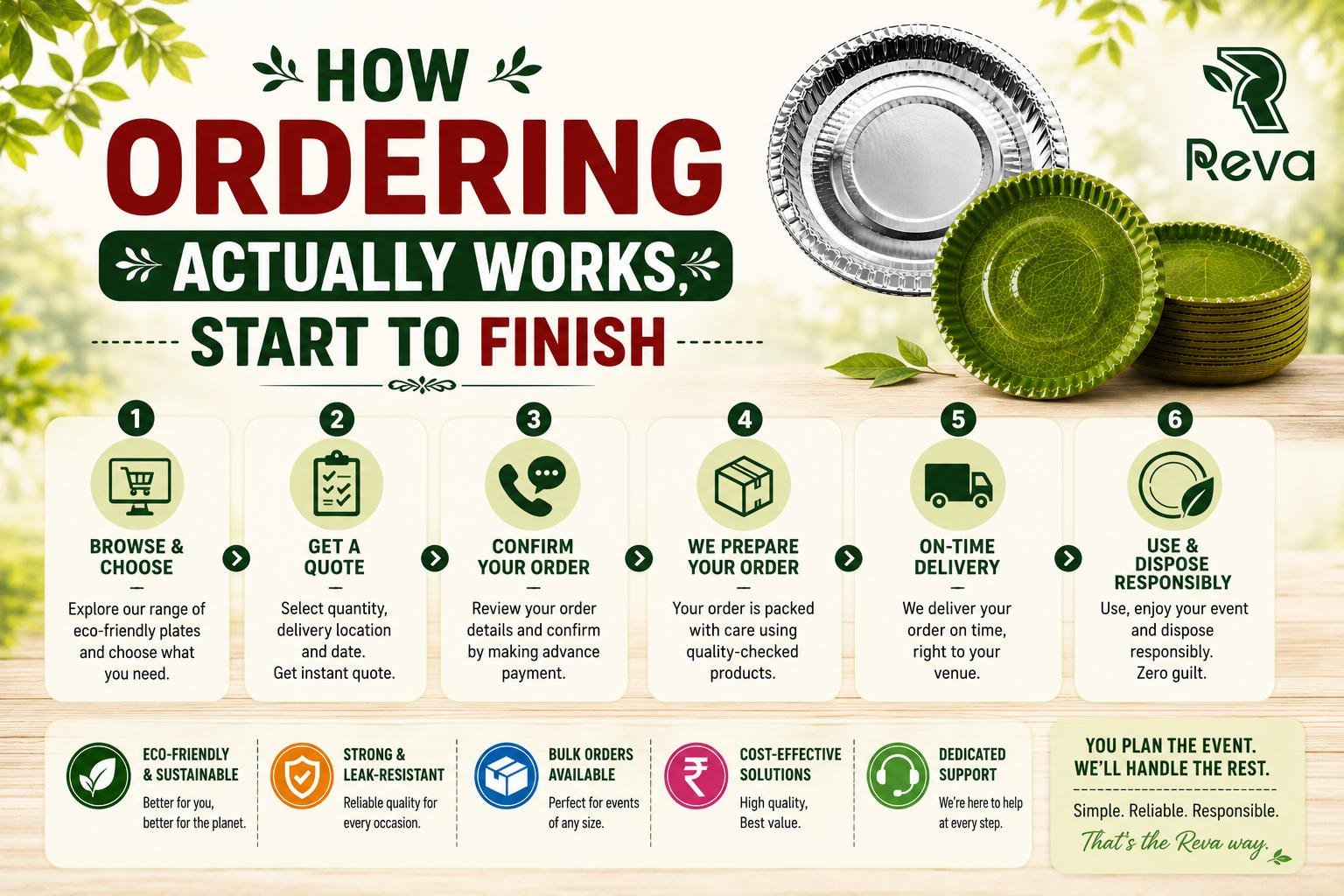
Buyers who have never ordered direct from a manufacturer often expect it to be complicated. It is not, but it does run on specifics.
Sizes, quantity and your city. That is enough for a written, size-wise rate. Any bulk disposable plates supplier can price a specific enquiry in minutes. Vague enquiries get vague answers — “what is the rate for paper plates” cannot be answered honestly without knowing whether you mean 6″ or 12″, five hundred pieces or fifty cartons.
Ask for a sample carton. Press quality, board stiffness and crimp depth are far easier to judge in your hand than in a photograph on a directory listing. One carton is a small price for certainty on a five-thousand-plate order. Any bulk disposable plates supplier confident in the goods will send one without arguing.
Get the pieces-per-carton figure in writing along with the rate, and agree the dispatch date rather than the delivery date, so transport time is accounted for separately. A bulk disposable plates supplier that will not commit a dispatch date in writing is telling you something useful. From our unit at Kankasiya we run weekly loads across Dahod, Jhalod, Limkheda, Fatepura, Devgadh Baria, Godhra and Santrampur, reach Halol, Vadodara, Anand and Ahmedabad for larger orders, and hand over to a transporter for anything beyond.
This one costs organisers real money. Paper board absorbs moisture. Cartons stacked directly on a floor during a wet October will soften at the base, and softened plates crack at the crimp. Keep cartons on a wooden pallet or a plastic sheet, away from outside walls, and open only what you need each night.
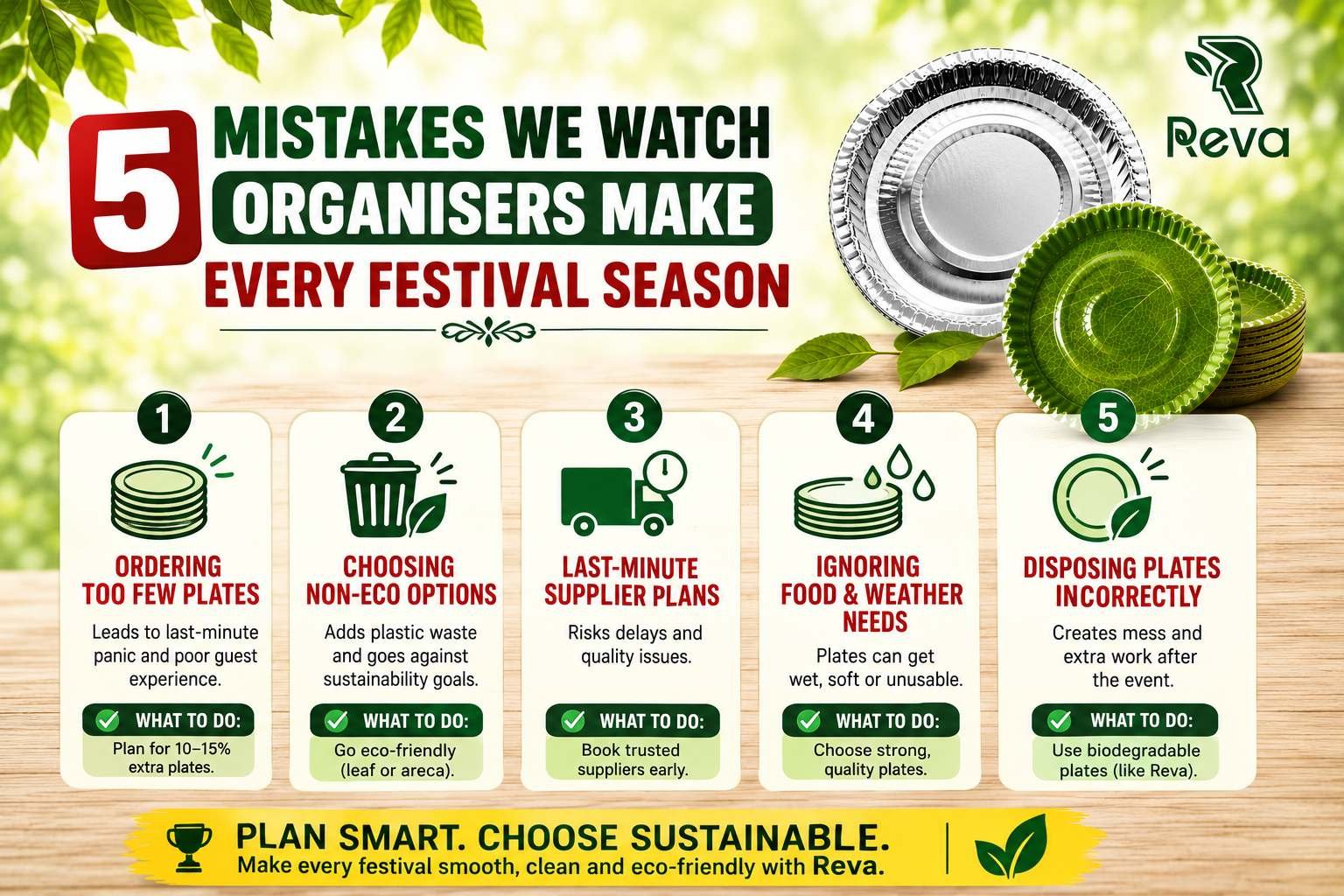
A single 10″ plate for prasad, main meal and snacks means you overspend on the small servings and under-serve the large ones. Two sizes cost less overall than one wrong size.
The bowl is remembered on night one, at the counter, when the dal has nowhere to go. It is the single most common mid-festival emergency call we get, and eco friendly disposable plates without matching bowls only solve half the problem.
Cups go roughly 1.3 times faster than plates. Ordering them one-to-one guarantees a shortfall by night four. Whatever quantity of paper plates for garba service you settle on, take the cup figure separately.
Three suppliers means three dispatch dates, three quality standards and three people to chase when something is short. The paise saved disappear the first time a load of paper plates for garba night four arrives a day late. Consolidating with one bulk disposable plates supplier gets you a better slab rate and one phone number that answers.
Every year, someone confirms in the first week of October because the committee met late. By then the sizes they wanted are committed to buyers who moved in September. Book the quantity early with your bulk disposable plates supplier; committees can settle the rest afterwards.
There is a difference between a trader who calls himself a bulk disposable plates supplier and a unit that presses plates. A trader cannot fix a pressing fault, cannot add a size mid-week, and cannot commit to a dispatch date without checking with somebody else first. That is the practical limit of a reselling bulk disposable plates supplier. When ten thousand people are expected on a Saturday night, that gap matters, and it is the clearest test of whether your bulk disposable plates supplier actually owns the machines.
Reva Disposable is a working unit at Kankasiya, Fatepura, in Dahod district, founded by Jaivik Patel. Paper board goes in one end and counted cartons come out the other. Nine people work here, most from villages within ten kilometres, and buyers are welcome to walk the floor on any working day and watch a plate come off the press. That is the reason we can act as a bulk disposable plates supplier and quote a rate in the morning while committing to a dispatch date in the same message. You can read more about the unit on our about page, or see the full range on the products page.
Because every line here runs eco friendly disposable plates and nothing else, there is no awkward question about what else is made on the same machine. For festival paper plates in Gujarat, buying direct also removes a layer of pricing. The rate you get is the factory rate, and for standing monthly quantities it moves to a slab instead of being requoted every fortnight.
If you take one thing from this guide, take this summary. It is the whole decision in six lines, and it applies whether you are a mandal secretary ordering paper plates for garba service or a distributor stocking festival paper plates in Gujarat for resale.
Send those seven lines on WhatsApp and you will have a size-wise rate list back the same working day. That is the fastest route to booking bulk paper plates for events this season, and it takes less time than the committee spends deciding the theme.
1. When should I order disposable plates for Navratri 2026?
Place a confirmed order by the third week of September 2026. Navratri runs from 11 to 19 October, and manufacturing lines fill on a first-come basis roughly four weeks ahead. Buyers who order disposable plates for Navratri in late September get the sizes they asked for; buyers who call in October get whatever is still running. Ask your bulk disposable plates supplier to confirm the dispatch date in writing.
2. How many plates do I need for a 500-person garba?
For 400 people eating out of 500 attending, one meal a night for nine nights, plan about 5,040 plates of 10″, 2,825 bowls and 6,450 cups of 100ml, including a 12 per cent buffer. Round each line up to a full carton. If you serve two wet items, double the bowl figure.
3. Which plate is right for gravy and dal at a garba?
Silver foil laminated plates. The foil layer stops oil and gravy soaking into the board. Use 10″ for a three-item thali and 12″ if rice and a sweet are added. Most eco friendly disposable plates sold for festival catering in Gujarat are this silver foil type. Keep paper plates for garba snack counters — the leaf print range — for dry items like fafda, dhokla and sweets.
4. Are thermocol plates still allowed at public festival events?
No. Thermocol and identified single-use plastic tableware have been prohibited in India since July 2022 under the Plastic Waste Management Rules, and public events are among the easiest venues to inspect. Eco friendly disposable plates that are fully paper based keep the organiser on the right side of the rules.
5. What is the minimum quantity for a bulk festival order?
Wholesale usually starts from one carton per size, and mixed sizes can travel on a single dispatch, which is the normal way festival paper plates in Gujarat are shipped. Most festival buyers land between ten and forty cartons, which is where slab pricing begins. A bulk disposable plates supplier should give you the pieces-per-carton figure before you confirm.
6. Can I get plates delivered outside Dahod district?
Yes. We run weekly loads across Dahod, Jhalod, Limkheda, Fatepura, Devgadh Baria, Godhra and Santrampur, and reach Halol, Vadodara, Anand and Ahmedabad for larger orders. Anything beyond goes by transporter, so festival paper plates in Gujarat can reach most districts inside the same week. Buyers looking for festival paper plates in Gujarat outside these routes should send the city with the enquiry so freight can be quoted separately.
7. Can I see a sample before placing a festival order?
Yes, and you should. Ask for a sample carton before committing to bulk paper plates for events. Board stiffness and crimp quality are far easier to judge in your hand than in a listing photograph. Buyers are also welcome at the unit in Dahod on any working day to see how their paper plates for garba and bhandara service are actually pressed.
